

Integrating HBOT into Surgical Practice
A Practical Framework for Using Hyperbaric Oxygen in Tissue Salvage, Reconstruction, Trauma, Infection, and Radiation-Damaged Wounds Hyperbaric oxygen therapy, commonly
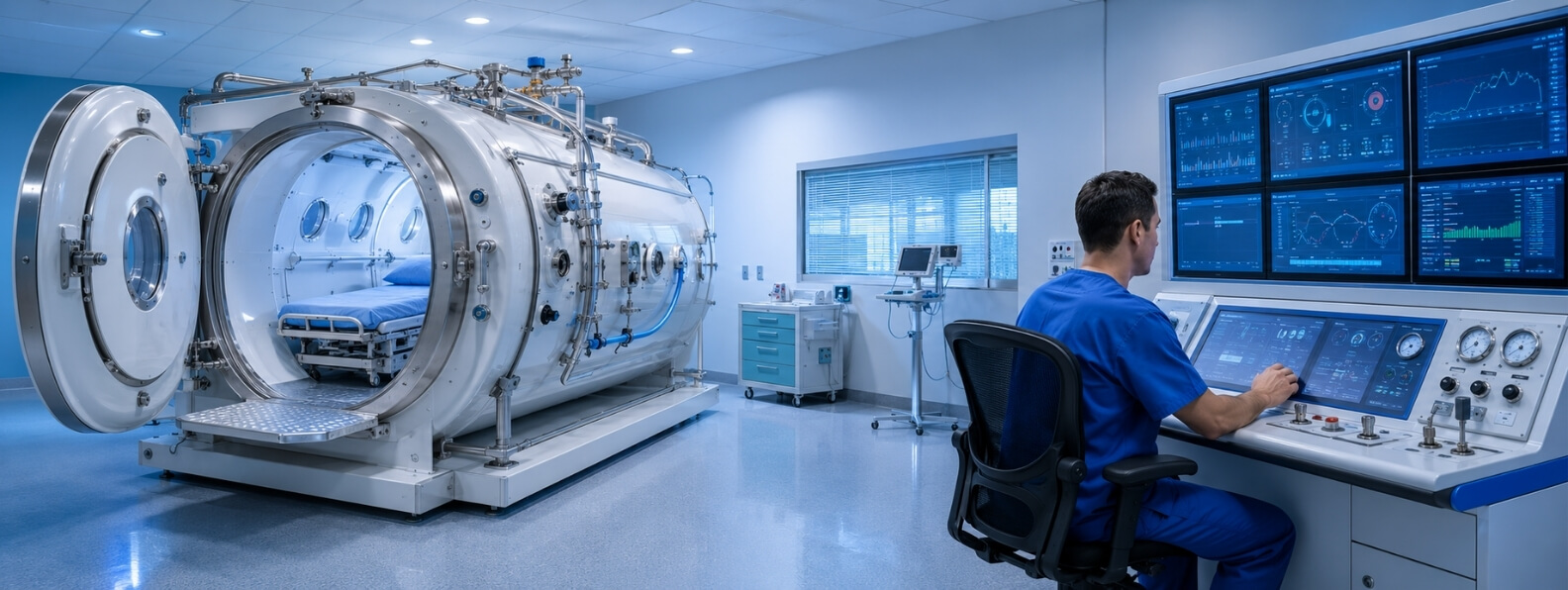
New hyperbaric chamber technology is not primarily about reaching higher pressures. Modern medical chambers already operate within pressure ranges adequate for established hyperbaric oxygen therapy and therapeutic recompression protocols. The more consequential advances involve how chamber systems control pressure, manage treatment gases, monitor patients, detect environmental changes, support critical care, and document maintenance.
Hyperbaric chambers remain Class II medical devices in the United States. The FDA clears these devices through the 510(k) process, and cleared systems can be identified through product code CBF. In August 2025, the agency reminded facilities that technological sophistication does not replace staff training, continuous patient supervision, grounding, fire prevention, maintenance, and strict control of items introduced into the chamber. (U.S. Food and Drug Administration)
The direction of chamber development is therefore best described as safer integration. Pressure-vessel engineering remains the foundation, but newer systems increasingly combine that structure with digital controls, environmental sensors, treatment-data capture, improved patient access, and equipment designed for more complex clinical care.
A hyperbaric chamber must safely contain one or more people while maintaining a controlled pressure differential. New software, monitors, and treatment features have limited value when the underlying vessel, windows, doors, penetrations, piping, or pressure-control systems are not engineered and maintained properly.
The current ASME PVHO-1 standard is the 2023 edition. It establishes requirements for the design, fabrication, inspection, testing, marking, and certification of pressure vessels for human occupancy and their associated piping systems. Medical hyperbaric chambers, recompression chambers, diving bells, and related pressure vessels fall within its scope. (ASME)
Post-construction safety is addressed separately. The 2025 edition of ASME PVHO-2 provides technical criteria for the operation and maintenance of vessels built under PVHO-1. It also addresses the continuing serviceability of acrylic windows under their specific environmental and operating conditions. (ASME)
These standards illustrate an important point about chamber technology: innovation must account for the entire equipment lifecycle. A chamber is exposed to thousands of compression and decompression cycles, repeated cleaning, environmental stress, oxygen service, mechanical wear, and changes in installed equipment. Long-term safety depends on inspection and maintenance as much as original design.
Hospitals should verify which editions of ASME, NFPA 99, building codes, and local regulations have been adopted by the authority having jurisdiction. The newest published standard is not necessarily the edition legally enforced in every location.
Older chamber systems relied more heavily on mechanical gauges, manual valves, and operator calculations. Modern chambers increasingly use human-machine interfaces, programmable controls, electronic pressure sensing, and visual treatment-profile displays.
An FDA-cleared multiplace chamber system provides an example of this architecture. Its touchscreen control console can initiate and monitor treatment, administer breathing gases, monitor oxygen, optionally monitor carbon dioxide, track relative humidity, regulate temperature, operate compartment doors and lighting, and support administrative functions. The system also incorporates manual backup controls for pressurization and depressurization if the automated feature becomes unavailable.
Potential advantages of digital controls include:
Automation can reduce some forms of human error, but it introduces software, sensor, power, and interface failure modes. Manual control capability remains essential. Staff must understand how the chamber behaves. Staff must understand how the chamber behaves when a touchscreen freezes, a sensor becomes inaccurate, an automatic valve fails, or power is interrupted.
A digital chamber should not become an unattended chamber. The FDA continues to require appropriate patient monitoring and supervision throughout trea(U.S. Food and Drug Administration)he degree of automation. citeturn529094view0
Environmental monitoring is becoming a more important area of chamber development. Pressure alone does not describe the condition inside the vessel.
Depending on chamber type and operating method, the clinical team may need to monitor:
In a multiplace chamber, the vessel is commonly pressurized with air while patients receive oxygen through masks, hoods, or ventilator circuits. Oxygen leakage from these systems can increase the ambient chamber oxygen concentration, so ventilation and oxygen analysis are central fire-safety controls.
A monoplace chamber is commonly pressurized with oxygen, making environmental measurement important for different reasons. Oxygen is consumed, carbon dioxide is produced, heat and humidity may accumulate, and the sampling location may not perfectly represent the environment immediately surrounding the patient.
A 2024 study evaluated a mechanically improved gas-monitoring system for monoplace chambers. The investigators measured oxygen, carbon dioxide, humidity, and temperature at different pressures and found that sampling-system design could affect how accurately the monitor represented conditions inside the chamber. The project highlights the need to validate sensors, sampling lines, cooling systems, and gas-flow patterns under actual hyperbaric conditions rather than assuming that a surface-calibrated mo(PubMed Central (PMC))ure. citeturn577741search0turn577741search4
Future systems may incorporate redundant sensing, automated calibration reminders, rate-of-change alarms, and continuous trend displays. The meaningful advance will not simply be the addition of more numbers. It will be the ability to distinguish a true environmental hazard from sensor drift, sampling delay, condensation, or equipment malfunction.
Traditional alarms may indicate high pressure, low gas supply, elevated oxygen concentration, loss of power, or another equipment abnormality. More advanced systems can compare multiple data streams and provide context-sensitive alerts.
A treatment-verification system could theoretically compare:
This could help detect an incorrect protocol before treatment begins or identify a difference between the prescribed and delivered oxygen dose.
Digital verification should be designed carefully. Excessive or poorly prioritized alarms can produce alarm fatigue, while automated documentation can reproduce incorrect information throughout the medical record. Hyperbaric programs still need a deliberate pre-treatment safety pause in which qualified personnel verify the patient, diagnosis, chamber, pressure, gas, duration, air breaks, and emergency plan.
Fire remains one of the most consequential hazards in hyperbaric medicine. Elevated oxygen concentration does not independently ignite, but it makes combustible materials easier to ignite and allows fire to burn more rapidly and intensely.
Modern multiplace systems may incorporate fixed fire-deluge systems, hand lines, oxygen analyzers, ventilation controls, emergency gas shutoff, pressure-rated water storage, alarm systems, and centralized activation from the control console. An FDA 510(k) summary for a multiplace system describes both a primary deluge system and a system. citeturn740981view0turn529094view5
No fire-suppression system makes ignition acceptable. The primary strategy remains prevention through:
The FDA’s 2025 safety communication followed reports of serious injuries and deaths associated with HBOT devices. The agency specifically emphasized proper grounding, avoidance of prohibited electrical or static-producing items, compatible clothing, staff education, supe(U.S. Food and Drug Administration)rer-defined maintenance. citeturn529094view0
Future fire-safety systems may include more responsive oxygen sensors, automatic ventilation adjustment, equipment identification, electronic pre-treatment checklists, and improved detection of abnormal heat or electrical activity. These technologies should reinforce strict material control, not create permission to bring ordinary consumer electronics into an oxygen-enriched chamber.
Clinical monitoring under pressure presents unique engineering challenges. Gas-filled components change volume, gas density increases, pressure can alter equipment calibration, and electrical devices may create ignition or compatibility concerns.
Stable outpatients may require relatively basic observation. Critically ill patients may require:
International critical-care guidance states that monitoring and treatment should not be reduced merely because the patient is receiving HBOT. Chambers intended for intensive-care patients should be equipped to continue necessary organ support, and every device introduced into the chamber shou(PubMed)ed for hyperbaric use. citeturn974827search1
Equipment performance may change with pressure. Increased gas density can influence ventilator flow, airway resistance, delivered tidal volume, and carbon dioxide clearance. Some monitoring values require pressure-specific interpretation. Critical-care HBOT therefore depends on more than fitting equipment through the chamber door. It requires performance testing, fire-safety assessm(PubMed)ing. citeturn974827search3turn974827search6
New chamber technology is increasingly valuable when it allows the hospital to maintain ICU-level care instead of interrupting it.
Point-of-care ultrasound is emerging as a potentially useful tool inside multiplace chambers. It could allow clinicians to assess cardiac function, pulmonary findings, vascular access, free fluid, or other acute changes without decompressing solely to obtain bedside imaging.
A 2023 proof-of-concept study evaluated a wireless handheld ultrasound device in a multiplace hyperbaric environment. The device maintained image quality and wireless connectivity during testing, allowing it to communicate with a display outside the chamber. The investigators also identified a pressure-related issue involving the device’s power button, demonstrating why apparently suitable consumer-style electronics require formal hyperbaric e(PubMed)ion. citeturn281193search0turn281193search2
This work does not mean that any wireless ultrasound device can be carried into any chamber. Equipment must be evaluated for the exact chamber class, oxygen environment, pressure, battery system, enclosure, and intended clinical use.
The larger opportunity is significant. Safe wireless transmission could reduce the amount of powered equipment inside the chamber while allowing clinicians outside to view physiologic or imaging information in real time.
Mechanical ventilation under pressure has historically required specialized equipment and substantial staff expertise. Modern portable ventilators, monitors, and infusion systems may offer better performance and familiar ICU-style interfaces, but they still require validation at the pressures where they will be used.
Published hyperbaric equipment studies have tested transport ventilators at several treatment pressures and have demonstrated that some systems can perform adequately after structured evaluation. This type of testing measures delivered volume, airway pressure, oxygen concentration, triggering, alarms, and device temperature rather than assum(UHMS)d. citeturn974827search16turn974827search17
The most useful advances will provide:
Not every advanced ICU technology is currently compatible with hyperbaric treatment. Reviews have identified significant limitations with highly complex systems such as extracorporeal membrane oxygenation a(PubMed)r circulatory support. citeturn974827search3
Hospitals should define their chamber’s actual critical-care capability rather than assuming that any patient can be treated because a stretcher fits inside.
Contemporary chamber design is also addressing patient mobility, obesity, anxiety, and the need for direct care.
Acrylic monoplace chambers provide broad visual contact with staff outside the vessel. Newer configurations may offer greater internal diameter, powered patient-transfer systems, adjustable positioning, and improved communication. These features can make treatment more practical for patients with limited mobility or complex wounds.
Multiplace systems can be configured with multiple independently controlled compartments, allowing one section to remain at treatment pressure while another is used to transfer personnel or supplies. Rectangular chamber designs can provide a room-like interior, flexible seating or stretcher arrangements, and space for critical-care staff and equipment. FDA documentation for one rectangular multiplace family describes configurations with multiple compartments anections. citeturn740981view0turn529094view5
The choice between cylindrical, rectangular, monoplace, and multiplace systems should be based on clinical scope rather than appearance. A wider chamber may improve patient comfort but require greater construction, staffing, gas, fire-protection, and maintenance resources.
Temperature and humidity are clinical and operational variables, not simply comfort features. Compression can increase chamber temperature, while decompression can cause cooling. Patients may remain inside for several hours, and critically ill patients may have limited ability to regulate body temperature.
Environmental-control systems can manage heating, cooling, humidity, and airflow. Integrated monitoring allows operators to observe trends and adjust the chamber environment before discomfort or condensation becomes significant. FDA-cleared multiplace technology has incorporated temperature and relative-humidity ntral control interface. citeturn141888view0
Improved communication, lighting, visual access, noise reduction, and external entertainment displays may also help patients tolerate long treatment courses. These features can reduce anxiety and treatment interruption, but they must be engineered without introducing unapproved electrical devices into the chamber.
Hyperbaric treatment produces a large amount of technical information:
Digital systems can transfer some of this information directly into treatment records, reducing transcription and making it easier to review a delivered treatment profile.
The greatest value may be in connecting chamber data with clinical outcomes. A program could compare oxygen dose and treatment completion with wound healing, radiation-injury symptoms, graft survival, adverse events, or other indication-specific measures.
Direct data transfer should not eliminate clinical narrative. A pressure graph cannot explain why treatment was interrupted, why the physician modified the protocol, or whether the patient developed a new symptom.
Cybersecurity and change control also become relevant when chamber controls and medical records are networked. Hospitals need to determine who can modify treatment profiles, how software updates are validated, whether remote access is permitted, and how a safe manual mode is preserved during a digital outage.
Hyperbaric facilities have traditionally relied on scheduled preventive maintenance, cycle counts, inspection records, and manufacturer service intervals. Newer sensor and data systems create the possibility of more predictive maintenance.
A system may eventually detect trends involving:
Predictive analytics could identify deterioration before it causes chamber downtime or creates a safety event. This approach should supplement the formal inspection and maintenance requirements established by the manufacturer, ASME standards, NFPA requirements, and the authority having jurisdiction.
The 2025 ASME PVHO-2 standard’s focus on post-construction operation, maintenance, and acrylic-window serviceability reinforces the importance of managing the complete chamber lifecycle rather than treating insta(ASME)the engineering process. citeturn529094view2
Portable and transportable pressure systems are being developed for military, maritime, remote diving, and disaster settings where access to a fixed recompression facility may require many hours.
Some systems are intended to provide initial recompression or transport under pressure before transfer into a larger treatment chamber. Divers Alert Network has described transportable systems designed to support injured divers in remote environments and, in selected (Divers Alert Network)nsfer under pressure. citeturn974827search31
These systems do not create a complete hospital hyperbaric program. Their safe use requires trained personnel, breathing-gas supplies, communications, monitoring, validated treatment or transfer protocols, and an identified receiving facility.
A portable chamber marketed for home or wellness use should not be confused with a medical recompression system capable of treating decompression sickness or an unstable patient.
A chamber may incorporate a touchscreen, additional sensors, a wider interior, or a new control architecture and still use the same fundamental therapeutic principles as an older system.
The FDA 510(k) pathway requires a manufacturer to demonstrate that a device is substantially equivalent to a legally marketed predicate device. The comparison may include intended use, design, energy delivery, materials, performance, safety, effec(U.S. Food and Drug Administration)ics. citeturn194639search0turn194639search4
Clearance establishes that the device can be marketed for its cleared use. It does not automatically establish that it produces better clinical outcomes than other cleared chambers.
Hospitals evaluating new technology should ask:
Marketing language such as smart, advanced, medical grade, or next generation should not replace regulatory and engineering documentation.
Flexible or low-pressure chambers are frequently marketed for wellness, recovery, athletic performance, and a broad range of unestablished uses. Their pressure, oxygen delivery, construction, fire protection, monitoring, and emergency capabilities can differ substantially from hospital hyperbaric systems.
The FDA advises facilities to confirm that an HBOT device is cleared and notes that cleared chambers can be identified through product code CBF. It also emphasizes following the instructions for the specific device, because safe operating requirements (U.S. Food and Drug Administration)e across chamber models. citeturn529094view0
A system should not be described as equivalent to hospital HBOT merely because it encloses a person and creates pressure. The delivered oxygen dose, pressure-vessel design, gas environment, supervision, and intended use all matter.
One of the most important limits of automation is the temptation to use it as a substitute for qualified personnel.
A chamber may automatically control pressure, time air breaks, record environmental measurements, and display patient video. It cannot independently perform a neurologic examination, interpret chest pain, recognize subtle confusion, protect a patient during a seizure, or determine whether urgent decompression creates more risk than remaining at pressure.
The FDA continues to emphasize trained staff and(U.S. Food and Drug Administration)or the entire treatment. citeturn529094view0
New technology should allow the hyperbaric team to detect problems earlier and respond more effectively. It should not justify unsafe patient-to-staff ratios, remote unattended operation, or reliance on one operator to manage more chambers than can be continuously observed.
A hospital or clinical program should assess new technology across several domains.
Clinical capability: Determine whether the chamber can safely treat the intended outpatient, emergency, pediatric, bariatric, ventilated, or critically ill population.
Engineering compliance: Verify pressure-vessel certification, fire-code compliance, medical gas requirements, electrical systems, environmental controls, structural requirements, and adopted local codes. ASME PVHO-1, ASME PVHO-2, and NFPA 99 r(ASME)n529094view1turn529094view2turn901302search8
Safety architecture: Review grounding, fire suppression, gas monitoring, emergency ventilation, backup controls, alarm behavior, prohibited-item management, and failure modes.
Equipment compatibility: Identify which ventilators, monitors, pumps, dressings, stretchers, and accessories have been tested for the exact chamber and pressure range.
Human factors: Observe whether controls are intuitive, alarms are prioritized, manual override is accessible, and staff can maintain visual and verbal contact with patients.
Data management: Determine how treatment profiles are stored, exported, secured, audited, and reconciled with the medical record.
Lifecycle support: Evaluate preventive maintenance, replacement parts, window inspections, service response, software support, staff education, and expected downtime.
The most advanced chamber is not necessarily the one with the largest touchscreen or highest advertised pressure. It is the system that allows a qualified clinical team to deliver the prescribed oxygen dose reliably, recognize deterioration quickly, manage emergencies safely, and maintain the equipment throughout its service life.
Future chamber development will likely bring better sensing, more complete treatment-data integration, improved critical-care devices, wireless monitoring, and earlier detection of equipment deterioration. Those advances are valuable when they strengthen the fundamentals of hyperbaric medicine: a sound pressure vessel, disciplined fire prevention, qualified personnel, continuous observation, and treatment tied to a defensible clinical indication.
A Practical Framework for Using Hyperbaric Oxygen in Tissue Salvage, Reconstruction, Trauma, Infection, and Radiation-Damaged Wounds Hyperbaric oxygen therapy, commonly

A Hospital Blueprint for Coordinated Diagnosis, Limb Preservation, Advanced Treatment, Hyperbaric Medicine, and Measurable Outcomes A multidisciplinary wound care program