

Integrating HBOT into Surgical Practice
A Practical Framework for Using Hyperbaric Oxygen in Tissue Salvage, Reconstruction, Trauma, Infection, and Radiation-Damaged Wounds Hyperbaric oxygen therapy, commonly
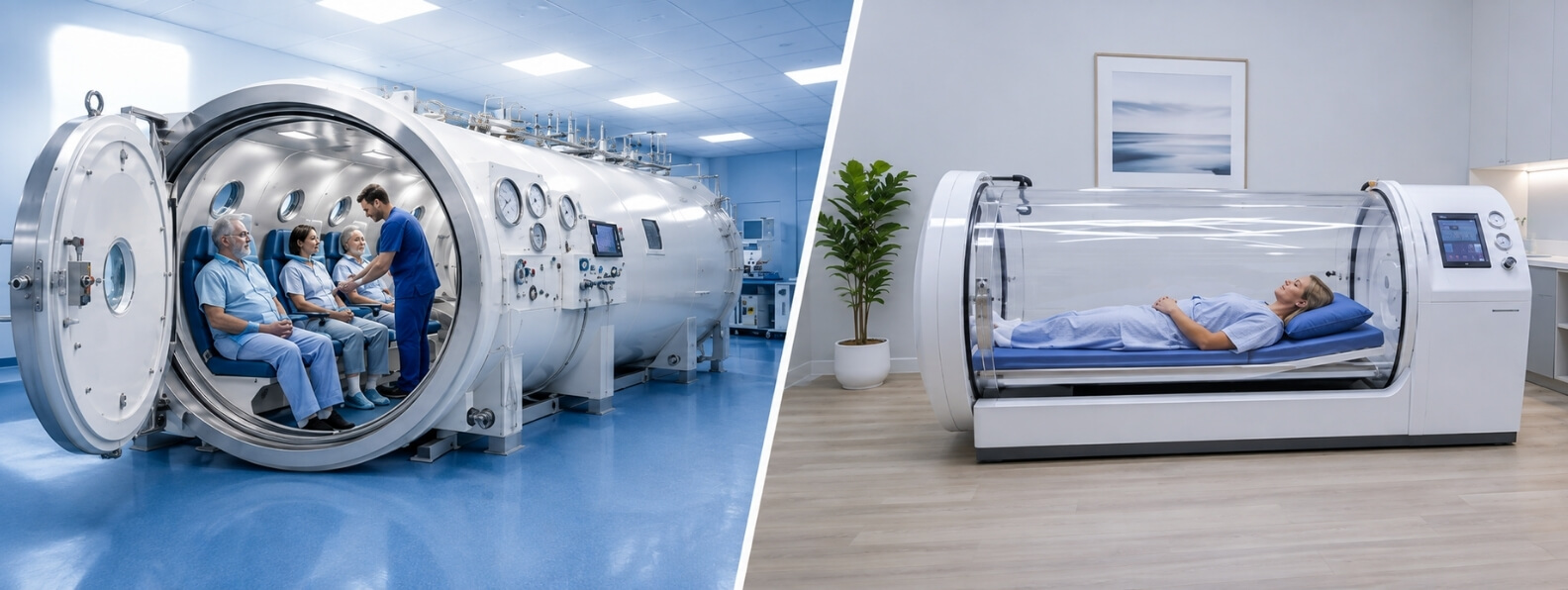
Hyperbaric oxygen therapy can be delivered in either a monoplace or multiplace chamber. Both systems expose the entire patient to increased atmospheric pressure while providing oxygen at a prescribed treatment dose. The principal differences involve how the chamber is pressurized, how oxygen is delivered, how many patients can be treated, and whether clinical personnel can remain inside during treatment.
Neither chamber type is inherently more therapeutic. When the same treatment pressure and oxygen exposure are delivered appropriately, the fundamental physiologic effects of HBOT remain the same. Chamber selection is usually based on patient acuity, staffing, facility design, treatment volume, equipment needs, safety requirements, and operational priorities.
A monoplace chamber is designed to treat one patient at a time. Most clinical monoplace systems consist of a horizontal pressure vessel with a clear acrylic section that allows staff to observe the patient throughout treatment.
The patient typically lies on a chamber stretcher that slides into the vessel. The chamber is then sealed and pressurized, commonly using medical-grade oxygen. Because the oxygen serves as both the breathing gas and the chamber atmosphere, the patient does not usually need to wear an oxygen mask or hood during the primary treatment periods. FDA-cleared monoplace chamber models are generally designed to administer oxygen at pressures greater than ambient pressure, with the precise operating range determined by the chamber’s specifications. (FDA Access Data)
The patient remains physically separated from the clinical team by the chamber wall. Staff communicate through an intercommunication system and monitor the patient visually, often with additional physiologic monitoring when medically appropriate.
The single-patient configuration can provide privacy and individualized scheduling. It also allows treatment profiles to be adjusted for one patient without affecting others.
A multiplace chamber is designed to accommodate more than one person. Depending on the system, patients may sit in reclining seats, remain on stretchers, or receive treatment in a configuration that supports more complex medical care.
Unlike a typical monoplace chamber, a multiplace chamber is generally pressurized with compressed air. Patients receive oxygen through an individually fitted delivery system, such as:
Clinical personnel can enter the chamber with the patients when the staffing model and treatment circumstances require it. This permits direct assessment, assistance with oxygen-delivery equipment, management of anxiety or ear-pressure difficulties, and hands-on care for patients who require closer supervision. CMS describes multiplace treatment as exposure to increased pressure in an air-filled chamber while oxygen is supplied through a mask, hood, or airway device. (Centers for Medicare & Medicaid Services)
Although multiple patients can be treated during the same session, each patient must still receive an individually prescribed treatment. Oxygen fit, breathing periods, air breaks, monitoring needs, and contraindications remain patient specific.
The most visible difference between the two chamber types is the treatment atmosphere.
In a conventional monoplace chamber, the chamber itself is commonly filled with oxygen. The patient breathes directly from the surrounding atmosphere. Air breaks, when included in the protocol, require a separate breathing system that supplies air while the chamber remains pressurized.
In a multiplace chamber, the surrounding atmosphere is compressed air. Oxygen is delivered directly to the patient through a mask, hood, or airway circuit. During an air break, the patient removes or switches from the oxygen-delivery device and breathes the chamber atmosphere according to the facility’s protocol.
Both approaches can produce the increased arterial and tissue oxygen tensions required for HBOT. The clinical oxygen dose is determined by several variables, including:
The chamber type does not replace careful dose selection. A patient does not receive a more effective treatment simply because the chamber is larger or because the chamber atmosphere contains oxygen. The prescribed pressure and verified oxygen exposure are the clinically important factors.
Physical access to the patient is one of the most important operational differences.
In a monoplace chamber, clinical personnel remain outside. Staff can observe and communicate with the patient, but they cannot immediately touch the patient or adjust equipment without ending or interrupting the treatment and decompressing the chamber.
This configuration is well suited to many stable patients who can communicate, follow instructions, equalize middle-ear pressure, and remain safely positioned during treatment. Monoplace systems can also be used for medically complex patients when the facility has appropriate protocols, compatible equipment, experienced personnel, and a treatment plan that accounts for the absence of an inside attendant.
In a multiplace chamber, a trained attendant may remain inside and provide direct care. This can be valuable for:
UHMS materials describe the treatment of critically ill and mechanically ventilated pediatric patients in multiplace environments when appropriate personnel and precautions are available. (UHMS)
Direct access does not eliminate risk. Personnel inside a multiplace chamber are also exposed to increased ambient pressure. Their cumulative pressure exposure, decompression profile, oxygen exposure, medical fitness, and staffing rotation must be managed carefully.
Both monoplace and multiplace chambers can support patient monitoring, but the equipment configuration differs.
In a monoplace system, monitors, ventilators, infusion pumps, and other devices may remain outside the chamber with approved tubing, cables, or interfaces passing through designated penetrators. Some equipment may be specifically designed or cleared for operation in a hyperbaric environment. Device compatibility must be evaluated for the chamber pressure, oxygen concentration, electrical characteristics, and intended clinical use.
A multiplace chamber may permit more equipment and personnel to remain near the patient, but every item introduced into the chamber must still meet facility safety requirements. Standard hospital equipment cannot be assumed to function safely or accurately under pressure. Increased pressure can affect gas-filled components, flow delivery, calibration, heat production, battery behavior, and device performance.
The ability to place an attendant beside the patient may make multiplace care more practical for certain unstable or intervention-dependent patients. However, critical care capability depends on much more than chamber size. It requires:
FDA clearances demonstrate that certain infusion and support systems have been evaluated for use under hyperbaric conditions, but facilities must follow the specific device labeling and chamber compatibility requirements. (FDA Access Data)
Fire prevention is a central safety concern in every hyperbaric facility. Increased pressure and elevated oxygen concentrations can cause materials to ignite more easily and burn more rapidly.
In a monoplace chamber filled with oxygen, the entire internal environment is oxygen rich. Clothing, linens, dressings, skin products, medical devices, and any item entering the chamber must be carefully controlled. Staff must follow established procedures for patient preparation, electrical grounding, static control, chamber cleaning, equipment approval, and prohibited materials.
A multiplace chamber is typically pressurized with air, which reduces the extent of the oxygen-enriched chamber atmosphere. However, oxygen can accumulate around leaking or poorly fitted masks, hoods, breathing circuits, or exhaust systems. The use of electrical and medical equipment inside the chamber also introduces safety considerations that require rigorous equipment review.
The different chamber atmospheres change the fire-risk profile, but they do not make either design free from fire hazards. Both monoplace and multiplace chambers require trained operators, controlled materials, documented maintenance, emergency procedures, and compliance with applicable hyperbaric safety standards. UHMS guidance emphasizes that patients in either chamber type depend on trained personnel for safe operation and emergency egress. (UHMS)
Monoplace chambers treat one patient per chamber cycle. Facilities may operate several chambers simultaneously, allowing each patient to begin treatment on a separate schedule and receive an individualized pressure profile.
This arrangement can provide operational flexibility. A delayed patient, shortened treatment, or protocol adjustment may affect only one chamber. Individual treatment can also reduce distractions for patients who prefer a quieter environment.
Multiplace chambers can treat several patients during one pressure cycle. This may offer efficient capacity when multiple patients require compatible treatment profiles. However, group treatment also requires coordinated scheduling. Patients generally compress and decompress together unless the chamber includes locks or other design features that permit personnel or supplies to enter and leave while the main compartment remains under pressure.
A clinical issue affecting one multiplace patient may alter the session for others. The facility must have protocols for managing oxygen intolerance, ear pain, anxiety, medical deterioration, equipment failure, or the need for an unscheduled decompression.
Throughput therefore depends on more than the number of available seats. It is influenced by chamber cycle time, staffing, patient preparation, oxygen-delivery setup, cleaning, emergency capacity, and the degree to which patient protocols can be grouped safely.
Patient comfort varies according to individual preference and clinical circumstances.
A monoplace chamber may feel more private and less medically busy. The transparent acrylic structure allows the patient to see outside, and many facilities provide audio or visual entertainment. Some patients appreciate being able to lie down throughout treatment.
Others may feel isolated or confined. Because the patient cannot remove themselves from the chamber independently, communication and reassurance from the outside team are important. Patients should understand how to report ear discomfort, anxiety, nausea, respiratory symptoms, visual changes, or other concerns.
A multiplace chamber provides a larger internal space and may allow patients to sit upright. The presence of other patients and an inside attendant can be reassuring. It may also make the experience feel more social and less confined.
However, patients must tolerate the oxygen-delivery interface. Masks and hoods can cause discomfort, pressure points, warmth, noise, or a sense of enclosure. Proper fitting is essential because oxygen leakage can reduce treatment efficiency and contribute to local oxygen enrichment.
Compassionate preparation matters in either setting. Explaining the sounds, pressure changes, communication system, oxygen equipment, and expected duration can substantially improve the patient’s ability to participate safely in treatment.
The therapeutic goal of HBOT is to deliver a defined exposure to oxygen at increased pressure. A correctly administered treatment can be delivered in either a monoplace or multiplace chamber.
Clinical outcomes are more likely to be influenced by factors such as:
The chamber type may indirectly affect outcomes when one design is better suited to a patient’s monitoring, mobility, ventilation, or staffing needs. For example, a patient requiring continuous bedside intervention may be more practically managed in a multiplace unit. A stable outpatient receiving a routine treatment series may be managed efficiently in a monoplace system.
The choice should be based on the level of care the facility can deliver safely, not on the assumption that one chamber design provides stronger oxygen.
For an individual patient, the most appropriate chamber is the one that can safely deliver the prescribed treatment while meeting that patient’s medical and psychological needs.
For a healthcare organization, chamber selection requires a broader assessment of:
Some programs operate only monoplace chambers. Others are built around a multiplace system. Larger centers may use both, allowing the clinical team to assign patients according to acuity, treatment protocol, scheduling needs, and available resources.
Regardless of design, a hyperbaric chamber is a regulated medical device intended to increase environmental pressure and promote oxygen movement into the body. Safe treatment depends on appropriate equipment, qualified personnel, patient screening, maintenance, and adherence to recognized clinical and technical standards. (eCFR)
A Practical Framework for Using Hyperbaric Oxygen in Tissue Salvage, Reconstruction, Trauma, Infection, and Radiation-Damaged Wounds Hyperbaric oxygen therapy, commonly

A Hospital Blueprint for Coordinated Diagnosis, Limb Preservation, Advanced Treatment, Hyperbaric Medicine, and Measurable Outcomes A multidisciplinary wound care program